Understanding Pityriasis Alba by a Dermatologist in Bogotá
What is Pityriasis Alba?
Pityriasis Alba is a benign and inflammatory skin condition, most common in childhood and adolescence. When it appears in adulthood, it is usually related to a tendency toward very dry skin, often in patients who do not follow proper skincare habits or use adequate skin-repairing treatments.
It is also known as streptogenic pityriasis or pseudoleucoderma atopicum. Its name comes from pityra (bran, husk of cereals) and albus (white), which is entirely consistent with its clinical appearance.
How does Pityriasis Alba manifest and how does it look on the skin?
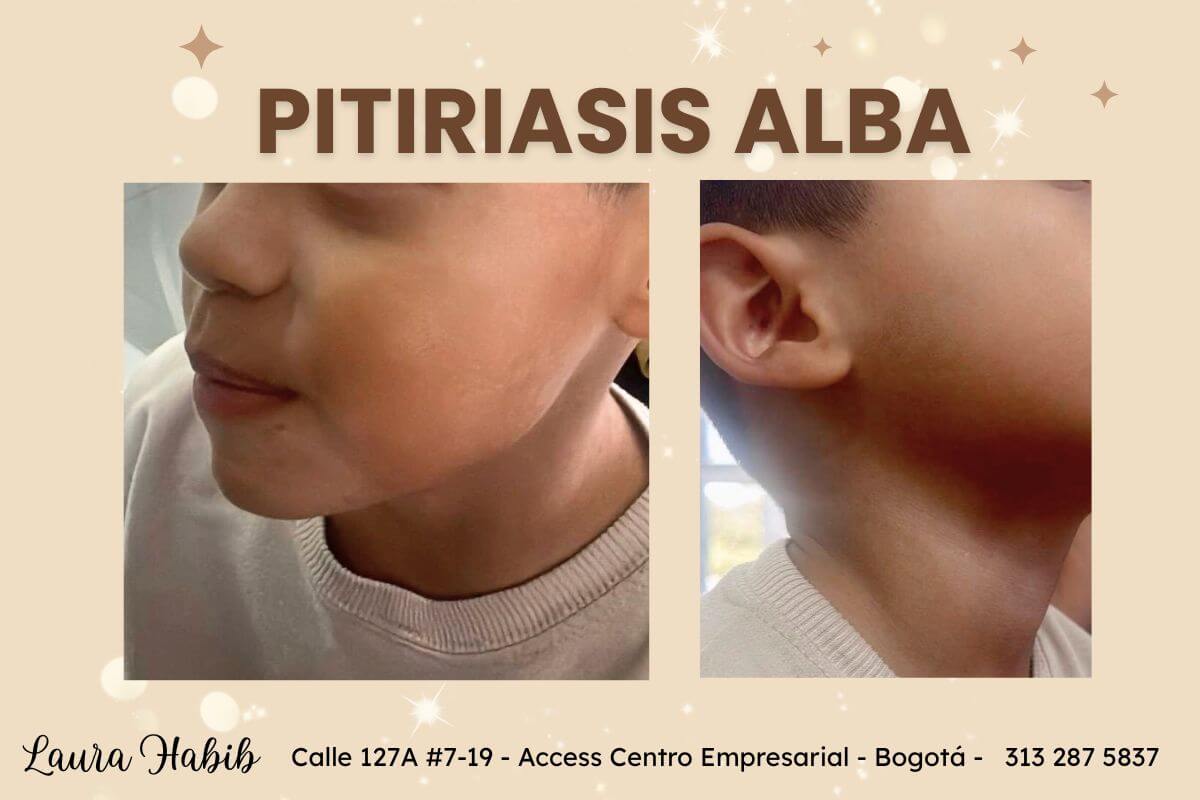
Classically, it is characterized by round reddish patches, which may appear as a single lesion, a few, or many at once. At the edges, there is a characteristic scaling that looks like powder or flour. These lesions are most frequently located on the face, upper chest, and arms.
A distinctive feature is that, over time, the scales fade and the patches become hypochromic (lighter than the normal skin tone) or even achromic (with loss of skin color). In addition, these patches become much flatter, almost level with the skin, resembling a mark or residual lesion.
How is it diagnosed?
The diagnosis is clinical, based on a dermatological physical exam. In general, biopsies (skin samples for pathological analysis) are not required unless there is some doubt and several diagnostic hypotheses are being considered.
Can it present in other forms on the skin?
Several clinical presentations have been described: the classic form (reddish at the beginning), the pigmented form, and the extensive or systemic form. The pigmented (darker) form is rare and usually occurs in patients with dermatophyte or fungal infections.
In the extensive form, the lesions are not reddish but hypochromic, less scaly, and last longer on the skin. They are asymptomatic and are more frequently observed on the trunk than on the face.
Is any skin type more prone to developing Pityriasis Alba?
It is more common in higher phototypes (darker skin tones).
What is the treatment?
Pharmacological measures
- Low-potency topical steroids / soft corticosteroids.
- Immunomodulators (calcineurin inhibitors).
- Calcipotriol, to control inflammation.
- Cleansers and lotions with exfoliating action (salicylic acid, glycolic acid, urea, etc.) — used in the final phase to even out skin tone.
- In cases of extensive pityriasis alba, phototherapy with ultraviolet A light (PUVA) and targeted phototherapy with 308 nm excimer laser may be used.
Non-pharmacological measures
- Daily emollients with skin-repairing properties. Active components in their formulation may include 5-Dex panthenol, alpha-bisabolol, and shea butter, among others.
- Adopting proper photoprotection habits to protect exposed skin: wearing covering clothing, seeking shade, avoiding peak sun exposure times, and not attending tanning centers.
- Follow-up with dermatology is important in all cases.
Medical Tourism in Colombia: Health and Relaxation in One Trip!
Experience the best of medical tourism in Colombia with personalized care, top specialists, and competitive prices. Combine health and travel in a single destination!
More InformationHealthcare by City
Discover the top doctors and dentists in Colombia's major cities.