Is it possible to love two people at the same time without being an asshole or a jerk?
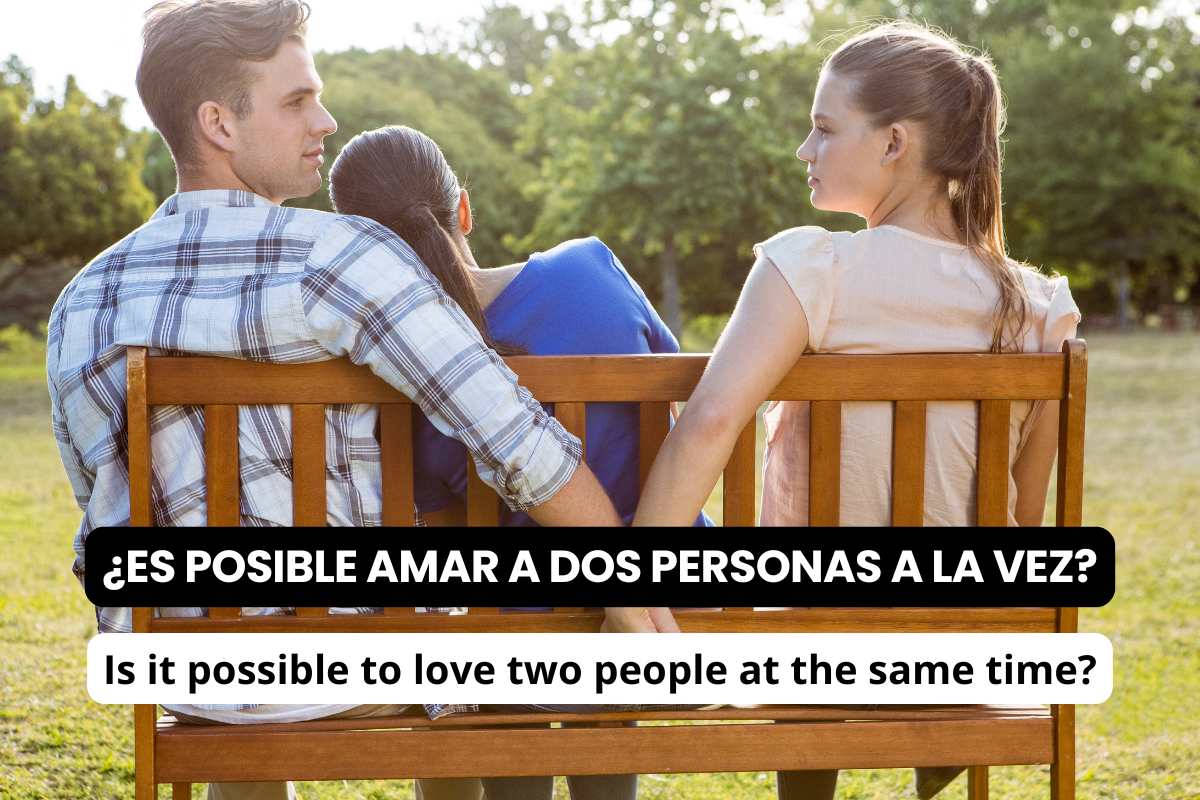
Then, based on what has been presented so far, love is more a decision of construction that can even go against desire, need or whim. In other words, the decision can also overcome passion; a level of consciousness in the couple that does not arise out of nowhere, not overnight, nor from a smile, a flirtatious look, physical attraction, a wink, crossed legs or a sexual encounter. To reach that level requires a certain degree of mental health and maturity.
Now then, at this point in the reflection, I think the question should be reformulated or posed differently, perhaps like this: Is it possible to love and desire, at the same time, two different people without being an “asshole” or a “jerk”?
The answer is yes. However, there is a thorny, thorn-lined issue to settle, which revolves around whether the person who decides to undertake this experience will do so by the path of loyalty (a route that could exempt you from the insulting labels included in the original question) or by the path of disloyalty — that is, whether they will reveal to their partner(s) the torment going on in their mind, or choose the role of the liar.
If they choose the second path, they will advance into a total process of breaching trust, in which —besides running the risk of being labeled, in Paquita la del Barrio terms, as a filthy rat, a lowly animal, scum of the earth, a poorly made monstrosity, an inhuman being, a specter of hell or a damned vermin— they also run the risk of definitively breaking the bond, the relationship.
This path will have other challenges, such as constant vigilance, tension, stress, agony and the wear of having to use friends as alibis, incur undeclared expenses and exceed one’s financial limits, hide calls, erase messages, align schedules and endure exhaustion, among other actions — a task that is not easy to sustain over time. Now then, the idea here is not to fall into prejudices, condemnations, self-condemnations or prophetic incapacities, nor into pathogenic guilt; we are human beings and living is a challenge for us, a test in which, fortunately, we have the right to err.
Regarding the first path —that of openly communicating the dilemma to the person(s) who should be told—, besides being ethical, it can be an interesting route to end the bipolar madness, that polarized thinking that sees only one no-way-out solution: having to choose one of your loves, deciding which of the two to stay with —one is heaven and the other a star—, whether the one that when it kisses you gives you life and wraps your soul with its caresses, or the one who waits for you at home, so sweet, noble and good, the one you love and who with faithful care has always looked after you, the one who loves and cherishes you.
Regarding this, I think this alternative (the first path) is a struggle only the brave have fought (as the song La dueña de mi suerte, performed by Rafa Pérez, says). It is an option that, in my view, must have as a premise not to harm anyone. Therefore, words must be chosen carefully and one must prepare to sustain not only an honest conversation but a mature, frank and empathic one —without defensive positions or justifications—, with truths, aiming at all costs to save a relationship (especially when children are involved, although not only for that reason). Whatever the relationship is called, the aim should be to safeguard the bond. Lack of preparation can, perhaps, increase the conflict, the suffering and the pain among the parties.
Undoubtedly, by taking this path (in which, perhaps in the realm of fantasy and imagination, you want to have both), the world may well fall apart for you. Despite your good intentions, it is a complex and difficult route to travel, as it moves away from a monogamous relationship accepted legally and morally in our current society, from what has been taught by the model of love, and by the moral guidance of a culture violent and disconnected from human feeling, perhaps more rooted in religion. You will clash with culture. But we must not lose sight of the fact that this type of relationship requires articulating processes such as intimacy, expenses, household responsibilities, relationships with the other person’s family members, quality time to share and the need for entertainment, among other aspects.
However, it is worth highlighting and valuing that this path reinforces one of the great pillars that uphold an important relationship: trust. Because the other person knows what to expect. Nevertheless, this path is only the tip of the iceberg, for the other parties will do their part too; the process can lead to the breakup of one relationship or both, and facing such a path, even if you do what is right, perhaps the only remaining option is to accept that it has ended. It is not the most passive option, because it begins another large task: mourning. However, by this route betrayal also comes to an end.
Loving and desiring two people at the same time is not a theoretical matter; it is daily bread in private practice. I particularly recall, in analysis, patients saying they love two incredible people at once. They reveal certainty that none of the loved parties will accept the triangle, which is absolutely reasonable in our Western culture. That position, they say, forces them to make a decision —a painful choice—, an experience lived with a high degree of anguish because of the immense suffering that grips their hearts. At that point some have told me, vehemently and distressed, that they do not feel capable of leaving either one. It is a very, very hard experience that manifests in the mind of the sufferer like a mental herniated disc; truly a terrible experience, where the exit is certainly not lobotomy. My silence in the face of such narratives is sepulchral. I recall some confronting me with displeasure saying, “Say something, don’t stay quiet — after all, I pay you, right? Tell me what to do.”
I usually ask them at that point: “What have you done to manage the situation?” Some share interesting coping strategies, among which are lists of pros and cons, analyses of qualities and defects and trips to disconnect a little. However, despite the interest of these exercises, they do not silence the pain that has already become flesh. This makes me think that, interesting as they are, those strategies are not the thing. Perhaps it is about accepting that, despite honesty and sincerity, the other person has some freedom (or less than you think) to not accept a polyamorous relationship. In fact, even with the best intentions, they may take the decision not to accept it. And there the complication begins, because loss becomes inevitable. Certainly no one can have everything they want in life; sometimes something must be lost. And although you may identify with the void created by what is lost, there is also the possibility that you connect with your transformation process.
At this point a couple of fatal questions often arise, which I usually put in place: “How do you do that, doctor? How on earth do you accept that something has to be lost? And how is the damage repaired?”
At this point it is inevitable that someone gets hurt. Keep in mind that every interpersonal relationship carries a risk, and two members of the trio took an important risk (consciously or unconsciously). So even though one should try to do the least harm possible, every decision has implications and consequences, and each card has its counter. And the counter appears. All parties in this conflict will have to assume the implications and consequences of their decisions; each will have to accept things, however painful. Also remember: the longer you delay making a decision, the more likely fate will decide for you — one of the parties of the trio, or both, will do it. If your strategy is not to make a decision, behind that is actually a signal of impossibility.
This dilemma is not solved by overthinking, ruminating, dramatic or impulsive solutions, nor by mistreating ourselves for feeling-thinking that we love two people at the same time. Even if we do so for misguided reasons (for the desires of others), those things make us human. And I tell you that, even when we make mistakes in our decisions, that does not make us assholes or jerks; it is a reflection that we are alive, a reflection of our humanity. Living it courageously, face to face, is ultimately a great opportunity to transform ourselves, to transcend. What does categorize us as such is the cruel treatment of another’s dignity, mockery. That said, it is pertinent not to lose sight that life should not be taken so seriously, and it is not true that there is usually only one way out of things. Rather, I invite you to consider that perhaps you are mistaken about something much more powerful and, ultimately, definitive: perhaps you are failing to value your mortality by believing you have all the time in the world to invest more than you really have in the face of certain challenges. For that reason you may be failing to make the most of your life. Therefore, I invite you to detect, differentiate and debate the feelings, thoughts and behaviors that make you feel ashamed of yourself when you close your eyes and that cause you to see yourself shapelessly in your inner mirror.
Notes
- [1] The @ sign is used because desire is not an exclusive field of men in couples, but also of women.
- [2] Among which we may mention: early models of love, the level of neuroticism and the quality of thoughts, among other psychological elements.
- [3] Because it is not easy to keep both God and the devil happy at the same time; in this way perceptions of incompatibilities in fulfilling commitments and loyalties may arise, perceptions that may generate or evoke unsustainable and ruthless demands from one or both parties of the love triangle; not out of malice or *#&%, but as a defense, as a voice protesting a representation of aggression, violence or indignation against one’s beloved.
- [4] A case worthy of study and analysis; and although it may seem severe today, I invite you humbly to see it from another point of view, as a sign that you are alive, as proof that you have tried what it means to be cannon fodder, a stumble that may eventually lead you to find yourself; however, this case is not always the order of our problems.
- [5] Rather than arising from a place of objectified desire.
- [6] That is why one can love and betray at the same time, and although less likely, one can also betray while in love; this is because even obsession does not stop desire.
- [7] Look, although I know that everyone builds their passions as they can (since we come with constitutive defects), I must warn you that if you decide to start a relationship with a lover, do not allow desire to be joined by love, because that is where the “horror” begins — the road to hell — in which you will not only buy your own condemnation but you do not know the anguish that awaits you; however, I also know that warning you will probably not help much, because sometimes the fright is impossible to avoid, as it pushes us into a pathological search to scratch our wounds, a compulsion to repeat that leads us to an abyss that captivates us, a place that some psychologists call jouissance.
- [8] Exploring the reasons why he or she wants to be your friend, the intention they have and knowing how they normally behave in their interpersonal relationships, exploring how they interpret the world and their circumstances, exploring their values, entertainment preferences and the way they resolve conflicts, among other traits, to reduce the risk of error in the choice.
- [9] If you are in a relationship when a process like this begins, and you are vulnerable in the realm of reality, imagination or fantasy at some point with regard to it, combined with your marks, inexperience with the matter or a dangerous moment involving alcohol, it is possible that you stumble into betrayal — you may stumble into yourself.
- [10] In closeness, sexuality or sex may come into play, and if you are lucky it may end in infatuation or in love itself; if not, a one-night stand may lead to an unwanted pregnancy, an STI, HPV or HIV, as has happened and still happens… or to an unhealthy habit of filling voids.
- [11] A statement that does not condemn us to betray, since, although it may not seem so, our nature is not instinctive, and although it is difficult, with great effort it is possible to avoid betrayal; fidelity is possible. Nevertheless, I warn you that there are things stronger than love and desire.
- [12] For this reason we are not free beings; what we have, at best, is a crumb of freedom.
- [13] But be careful, because we do not fall in love with just anyone; that person has a trait that connects us with them since childhood (a trait that can be physical or psychological), for example a way of looking, laughing, sitting or walking. What I want to express openly is that it is not as random a matter as it seems.
- [14] Well, in the end love is a risk, right? Love is not reliable, and whoever ventures into it must face its dangers, because there is no certainty in it; by the way, Caroline’s husband was Ricardo Izecsonn dos Santos, considered one of the best footballers in the world… in case you do not associate the name, he is better known as Kaka.
- [15] However, another valid question here is: will the parties in your love triangle want to share their beloved?
- [16] Yet I invite you not to condemn, and to consider that perhaps she is none of those things; perhaps it is the conduct of a human being with a lot, a lot, a lot of fear of losing you — you know that if she sees you with another man she will die; and if you die, she will go mad — that is, perhaps we are facing a double-edged dagger.
- [17] Lyrics adapted from the song “El dilema” by Silvestre Dangond.
- [18] Even more so, if children are involved.
- [19] Therefore I invite you to prepare yourself keeping in mind, besides honesty, criteria such as interest (care, protection and/or satisfaction of what each party needs or what matters to them), options (see and study possible agreements), alternatives (analyze and rule out rationally all things that could have been done before reaching an agreement), legitimacy (that the agreement or deal be fair, that is, give each person in proper proportion what they deserve, when they deserve it and as it merits), relationships (fight not to damage or injure the relationship) and commitments (fulfillment of promises).
- [20] Here I propose that the non-acceptance by them, or by one of them, may perhaps be due to a moral limit imposed by religion, not by nature (human); thus it is not true that there is an inscription in our species that prevents the parties in a love triangle from even living together in the same house and ending the problem once and for all, and thus focusing on what is important (transcend, live, seek happiness). Now, there is also no reason to publish these types of loves on social networks, nor at the workplace, right?
- [21] By this route you can make the most of your existence; perhaps you can make the most of the little time you have left… talk to yourself and speak frankly; maybe that way you will use your time better, maybe that way you will live and seek your happiness.

Medical Tourism in Colombia: Health and Relaxation in One Trip!
Experience the best of medical tourism in Colombia with personalized care, top specialists, and competitive prices. Combine health and travel in a single destination!
More InformationHealthcare by City
Discover the top doctors and dentists in Colombia's major cities.