Music Therapy for Older Adults in Bogotá: Music That Supports, Stimulates, and Connects
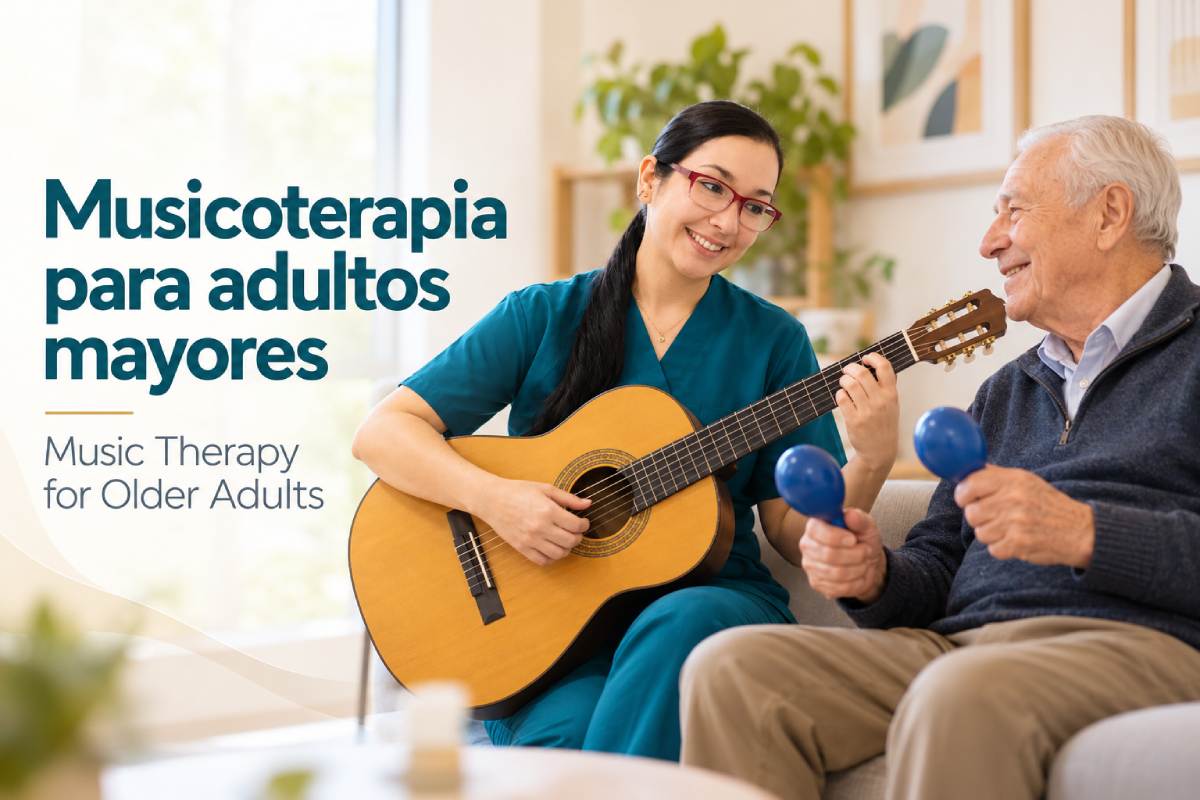
Does your grandfather spend the day in silence in front of the TV? Does your mother no longer want to go out, forget things, or seem sad? Many families face this situation and don't know what to do beyond the doctor's appointment. Music therapy for older adults is a gentle, enjoyable therapeutic option that complements medical treatment and helps the person reconnect with others and with themselves.
In this article, Mónica Quiroga Salazar, a music therapist in Bogotá, explains what it's for, what a session is like, and when it's worth considering.
What is music therapy for older adults?
It is a therapy that uses music to work toward specific goals: mood, memory, communication, movement, and relationships with others. It is not a music class or a concert. Older adults don't need to know how to sing or play an instrument: they take part at their own pace, based on what they can do and enjoy.
In a session, participants sing, listen to meaningful songs, play simple percussion, improvise, recall stories prompted by a song, and accompany movement with rhythm.
Why does music work so well in older age?
Music activates many parts of the brain at the same time: emotion, memory, movement, and language. That's why a person with memory problems often remembers every word of a bolero from their youth, or someone who barely speaks hums along to a familiar song. That door music opens is exactly what the music therapist works with.
Benefits of music therapy for older adults
- Better mood: helps reduce sadness, apathy, and boredom, and brings back moments of joy.
- Cognitive stimulation: musical activities engage attention, memory, and concentration in an enjoyable way, without feeling like an exercise.
- Memories and identity: songs from their era bring back stories, names, and places that strengthen their sense of who they are.
- Communication: singing and talking about music encourages self-expression, even when words are hard to find.
- Movement: rhythm invites movement of the hands, arms, and feet, and can support gait training.
- Calm: the right music helps during moments of restlessness, anxiety, or agitation.
- Connection: in group or family sessions, music creates spaces to share, laugh, and feel accompanied.
What does the science say?
The strongest evidence is in people with dementia. A Cochrane review published in 2025, which analyzed 30 studies with 1,720 participants, concluded that music therapy probably improves symptoms of depression and may improve behavioral problems compared with usual care (Cochrane, 2025). The same authors note that there is no evidence that music therapy stops memory decline, and that more long-term studies are needed.
In other words: music therapy does not cure Alzheimer's or reverse cognitive decline, but it can improve how the person feels day to day, and for a family, that means a great deal.
When is it recommended?
- Older adults who are sad, isolated, or have little motivation.
- People with mild cognitive impairment, Alzheimer's, or other forms of dementia.
- People with Parkinson's disease, as a complement to physical therapy and speech therapy.
- Older adults with chronic illness, pain, or in palliative care.
- Healthy older adults who want to stay active and connected.
It's always a good idea to discuss it with the treating physician, especially if there is an underlying condition.
What is a music therapy session like?
- Initial assessment: Mónica gets to know the person, their history, their musical tastes, and what the family hopes to achieve.
- Goals: specific goals are set, such as improving mood, stimulating memory, or reducing episodes of restlessness.
- Sessions: songs from the person's life, simple instruments, voice, rhythm, and movement are used, adapted to what the person can do.
- Follow-up: progress is reviewed with the family and, if authorized, with the treating physician.
Sessions can be individual or group-based, in person or online.
Music therapy for older adults in Bogotá with Mónica Quiroga Salazar
Mónica Quiroga Salazar holds a Master's degree in Music Therapy from the Universidad Nacional de Colombia, a professional degree in Music from the Universidad Distrital, and a specialization in Group Pedagogy, with 6 years of experience. She works with older adults, people with neurodegenerative diseases, and their families in individual, group, and online sessions.
She sees patients at three locations in Bogotá:
- Cra 19a No. 84-29
- Calle 135c No. 10a-26
- Cra 25 No. 37-78
Would you like your loved one to sing, remember, and smile again? Book an assessment with Mónica Quiroga Salazar via WhatsApp or through her MedicosDoc profile.
Frequently asked questions
Does my grandfather need to know music?
No. Music therapy is adapted to each person; what matters is taking part, not doing it "right."
Does music therapy replace medication?
No. It complements medical treatment and is never a substitute for it.
Can it help if my family member barely speaks anymore?
Yes, it can. Many people who communicate very little respond to familiar songs with gestures, humming, or movement.
Can it be done in a group or at a nursing home?
Yes. Mónica designs group programs for senior care homes and institutions.
Medical Tourism in Colombia: Health and Relaxation in One Trip!
Experience the best of medical tourism in Colombia with personalized care, top specialists, and competitive prices. Combine health and travel in a single destination!
More InformationHealthcare by City
Discover the top doctors and dentists in Colombia's major cities.